Matching Rhyming Picture Pairs to Feed a Monster
About this lesson
Kindergarten children spend about 40 minutes helping a picky cardboard-box monster named Gobble, who will only eat words that rhyme. They listen for matching ending sounds, feed rhyming picture pairs into the monster's mouth, and draw a rhyming pair of their own. You need a box with a mouth cut into it, index cards with simple drawings, paper and crayons.
- Grade
- Kindergarten
- Subject
- ELA
- Time
- 40 min
Objective
Students will identify pairs of words that rhyme by listening for matching ending sounds, and produce at least one rhyming pair of their own.
Materials
- A cardboard box or paper bag decorated as a monster with a large mouth cut out
- About 24 index cards with simple teacher-drawn pictures that make rhyming pairs (cat/hat, dog/log, sun/bun, bee/tree, car/star, fish/dish, cake/snake, frog/log, mouse/house, goat/boat, bug/rug, king/ring)
- Markers
- Drawing paper folded in half, one per student
- Crayons
Hook
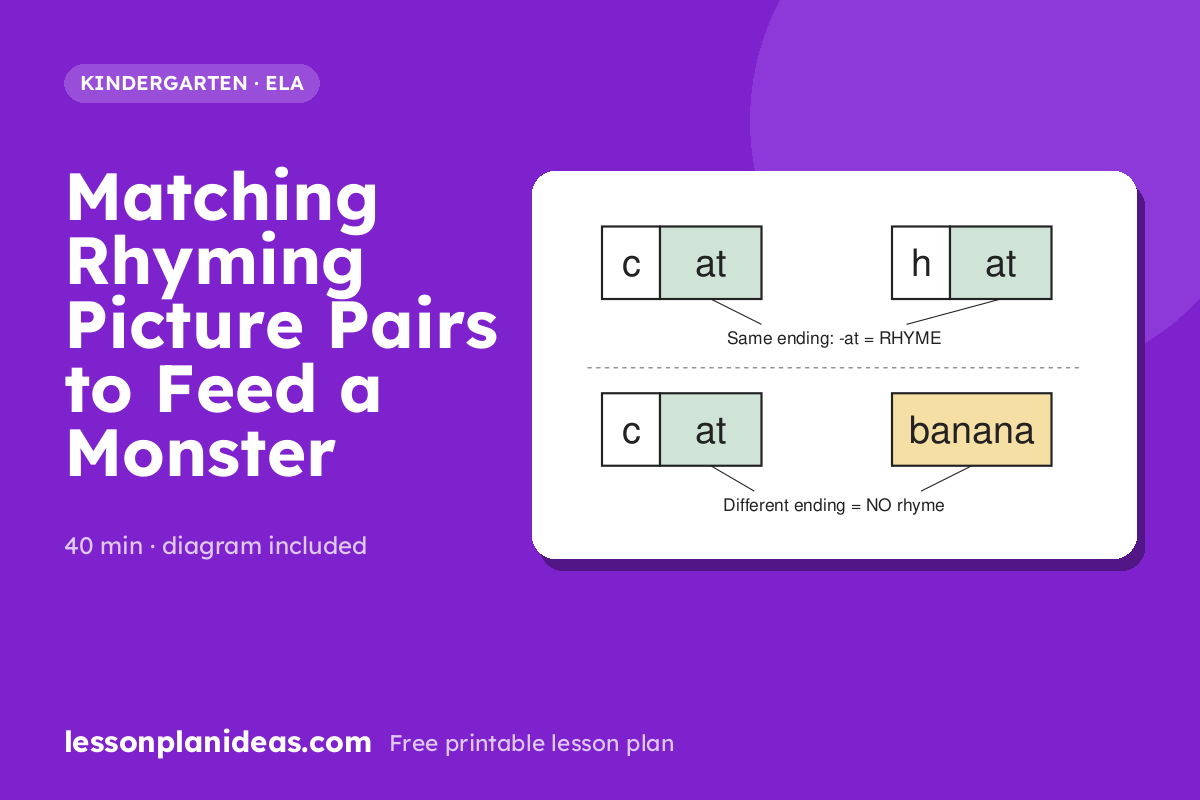
Bring out Gobble the monster box and use a deep, grumbly voice: 'I am SO hungry, but I am the pickiest monster in the world. I only eat words that RHYME!' Feed Gobble the cat and hat cards and have him munch loudly and say 'Mmm, cat-hat, delicious!' Then try to feed him cat and banana, and have Gobble spit the card out with a dramatic 'BLEH! Those don't sound the same at the end!' Let the children giggle, then ask them what Gobble likes to eat.
Main Activity
Gather students in a circle and explain that rhyming words sound the same at the end, like c-AT and h-AT. Model one round: hold up two cards, say both words slowly while stretching the ending sounds, and ask the class to give a thumbs up if they rhyme or a thumbs down if they don't. Then give each child one picture card and have everyone walk around the room saying their word out loud in a silly monster voice until they find the classmate whose word rhymes with theirs. When partners find each other, they march to Gobble together, say their two words loudly, and feed the cards into his mouth while the class checks with thumbs up or down (Gobble spits out any mismatches so the pair can try again). After all the pairs are fed, students go to their seats, draw a rhyming pair of their own on the folded paper (one picture on each side), and the teacher or child labels the words.

Discussion Questions
- How did you know your word and your partner's word rhymed?
- What part of the word sounds the same when two words rhyme?
- Can you think of a silly made-up word that rhymes with 'cat' that Gobble might like?
- Why do you think Gobble spat out the words that didn't rhyme?
- Where else do you hear rhyming words, like in songs or stories?
Exit Ticket
Each child whispers a rhyme into Gobble's mouth on the way out: the teacher says a word (such as 'pig,' 'bed,' or 'hop'), and the child says a word that rhymes with it. Real words and made-up words both count. Note which children can produce a rhyme on their own and which still need support.
Differentiation
Support: Give struggling learners a choice of two cards, one that rhymes with their word and one that doesn't, so they only have to compare two options. Say both words slowly with them and have them touch their mouth on the ending sound. Let them partner with an adult or peer helper during the search.
Extension: Challenge advanced learners to find a third word that rhymes with their pair, making a 'rhyme family' for Gobble (cat, hat, bat). They can draw all three on their paper and try to write the matching ending letters (such as -at) under each picture.