ELAGrade 3
Using Context Clues to Define Unknown Words
In this 45-minute Grade 3 lesson, children work as detective teams reading pages from a lost explorer’s journal. They use the words and sentences around each tricky word to work…
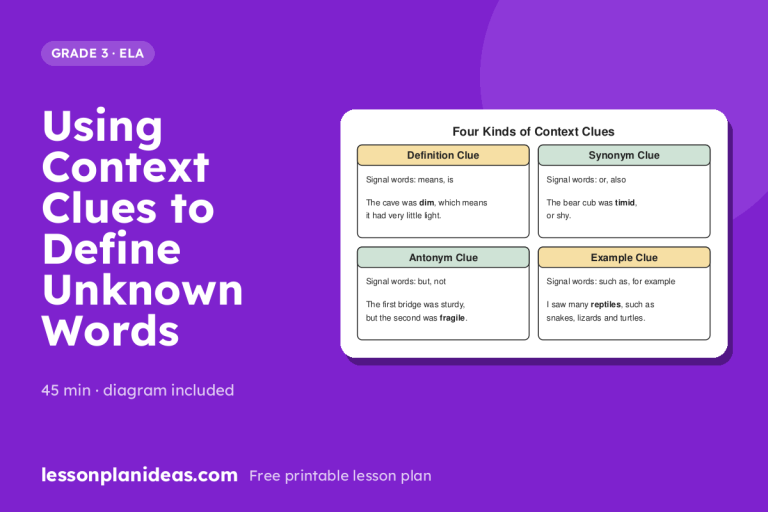
In this 45-minute Grade 3 lesson, children work as detective teams reading pages from a lost explorer’s journal. They use the words and sentences around each tricky word to work…
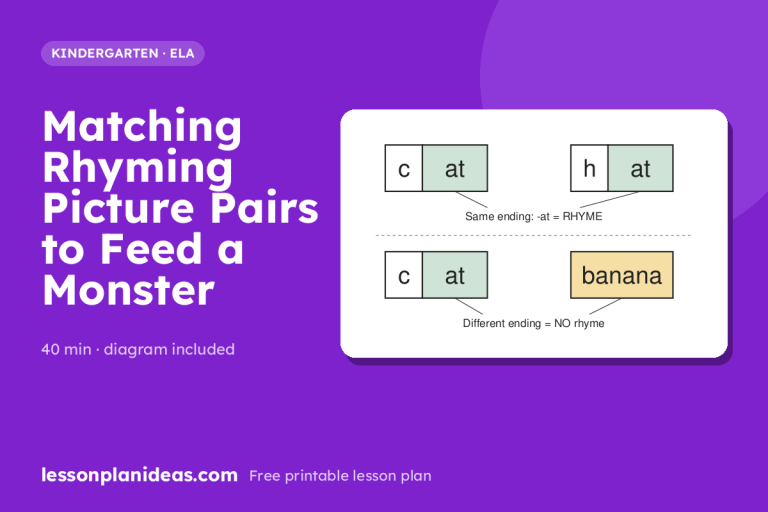
Kindergarten children spend about 40 minutes helping a picky cardboard-box monster named Gobble, who will only eat words that rhyme. They listen for matching ending sounds, feed rhyming picture pairs…
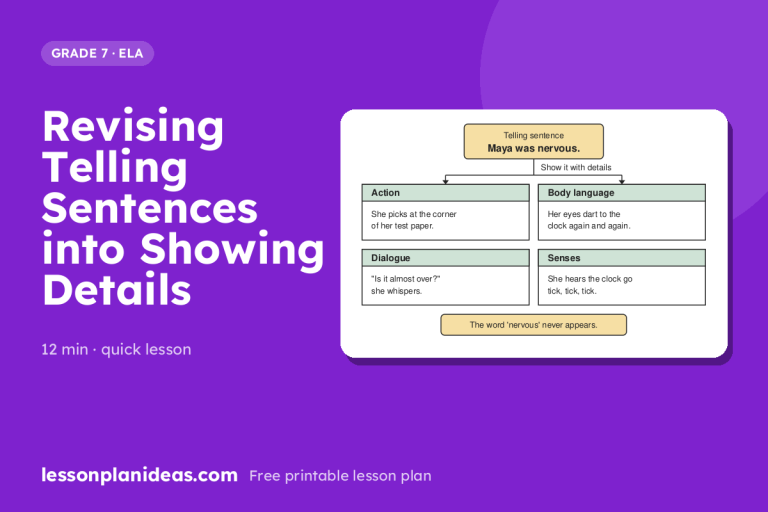
Students take flat sentences like ‘Sam was tired’ and rewrite them using actions, dialogue, body language and sensory details. Partners then guess the original sentence. This practises descriptive writing for…

Students spot passive voice sentences, find who is doing the action, and rewrite each sentence in active voice with a partner. They practise writing clear, direct sentences and talk about…
Students work in small groups to rank sets of similar words, such as thrifty, stingy and frugal, from most negative to most positive. They then use the words in their…
Over 40 minutes, Grade 1 children sit quietly with their eyes closed, notice the sounds in and around the classroom, and then write and illustrate sentences in a simple listening…

In this 45-minute Grade 3 lesson, teams combine base word cards with prefix and suffix cards (un-, re-, dis-, -ful, -less) to build real words. They earn points by explaining…

In this 40-minute kindergarten lesson, children listen for words that rhyme. Then they fold a sheet of paper and draw a rhyming pair, such as cat and hat, with one…

Children work in pairs to attach the prefixes un, re, dis and pre to base words. They explain how each prefix changes a word’s meaning and then use one new…

In this 45-minute Grade 5 lesson, students sit quietly to observe one small scene, record precise details in their journals, and shape those notes into a short free verse poem.…
Students look at passive voice sentences, work out who or what did the action, and rewrite each one in active voice. They also discuss when passive voice is a reasonable…
Students look at sets of words with similar meanings and decide which feel positive, neutral or negative. They then rewrite a sentence to change its tone. This practises noticing how…