Revising Telling Sentences into Showing Details
About this lesson
Students take flat sentences like 'Sam was tired' and rewrite them using actions, dialogue, body language and sensory details. Partners then guess the original sentence. This practises descriptive writing for narratives. You need a whiteboard and scrap paper, and it takes about 12 minutes.
- Grade
- 7
- Subject
- ELA
- Time
- 12 min
- Prep
- 2 min
Objective
Students will revise a telling sentence into 2-3 showing sentences that use actions, dialogue, body language or sensory details instead of naming the feeling or quality directly.
Prep
2 min: write five telling sentences on the board (Jordan was angry. The cafeteria was loud. Sam was tired. The old house was creepy. Priya was excited.)
Materials
- whiteboard and markers
- scrap paper
- pencils
Steps
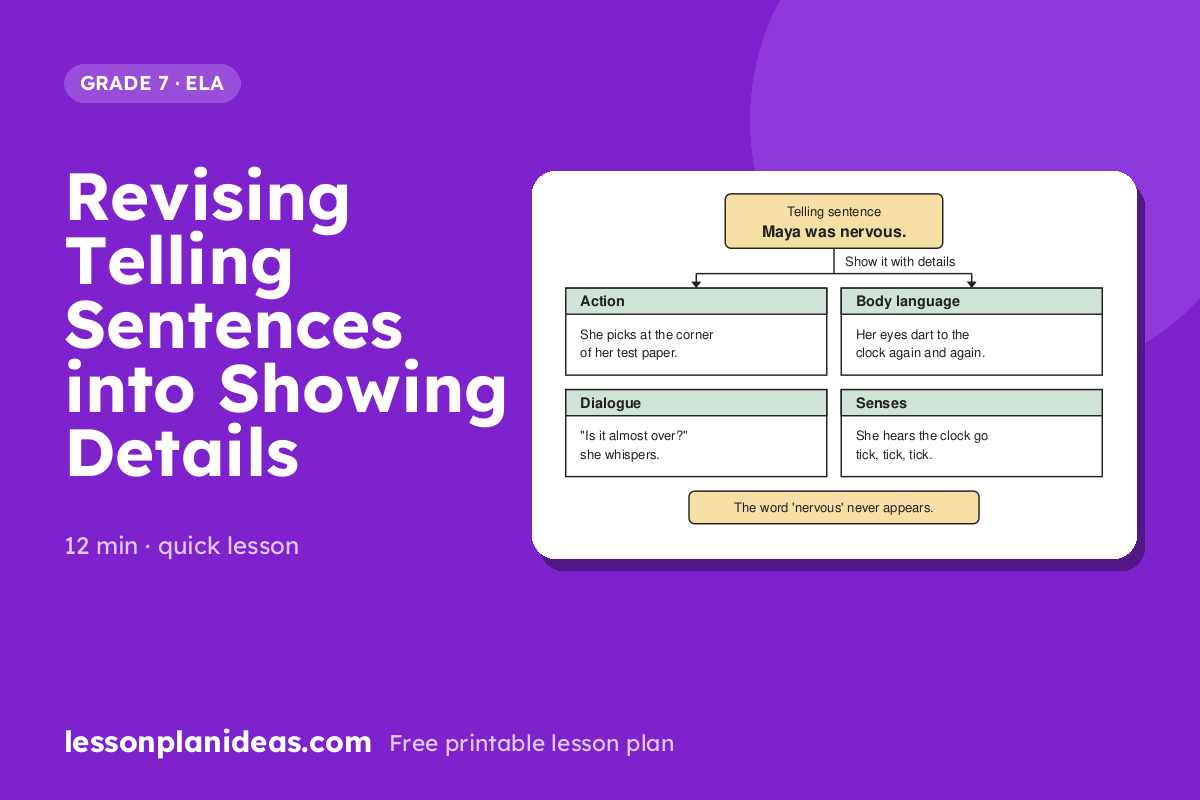
- Write 'Maya was nervous' on the board, then model a showing version aloud, such as 'Maya picked at the corner of her test, reread question one for the third time and glanced at the clock again.' Point out that the word 'nervous' never appears.
- Have pairs secretly choose one telling sentence from the board. Give them 4 minutes to write 2-3 showing sentences on scrap paper without using the key word (angry, loud, tired, creepy, excited).
- Pairs swap papers with another pair, who guess which telling sentence it shows and underline the single strongest detail.
- Invite 3-4 pairs to read their writing aloud. The class names the type of detail used each time: action, dialogue, body language or the senses.
- Each student writes one showing sentence for 'The classroom was messy' on their own and hands it in as they leave.
Quick Check
Read the exit sentences. Students who understood will describe specific things to see, hear or smell rather than using words like 'messy' or 'dirty'.
Differentiation
Make it easier: Brainstorm a word bank of actions and body language as a class before pairs write, or let pairs write just one showing sentence.
Make it harder: Require pairs to use at least two different senses and one line of dialogue, all within three sentences.
Good For
- Before lunch
- End of day
- Supply teacher
- Review