Testing the Pythagorean Theorem with Paper Squares
About this lesson
In this 50-minute Grade 8 lesson, students draw right triangles on centimetre grid paper, build a square on each side, then cut and rearrange the pieces to show that the two smaller squares fill the largest one. Afterward they use metre sticks and masking tape to check whether corners around the classroom are true right angles. You need grid paper, scissors, rulers, tape and metre sticks.
- Grade
- 8
- Subject
- Math
- Time
- 50 min
Objective
Students will demonstrate the Pythagorean theorem by constructing and rearranging area models, then apply it to determine whether real corners form right angles.
Materials
- Centimetre grid paper (several sheets per pair)
- Scissors
- Rulers
- Clear tape and masking tape
- Metre sticks or measuring tapes
- Markers or coloured pencils
Hook
Tape a large triangle on the floor with sides of 60 cm, 80 cm and 100 cm, and a second triangle with sides of 60 cm, 80 cm and 90 cm. Ask students to stand beside the triangle they think has a perfect square corner. Then ask how a builder could check a corner using only a measuring tape, with no protractor or set square.
Main Activity
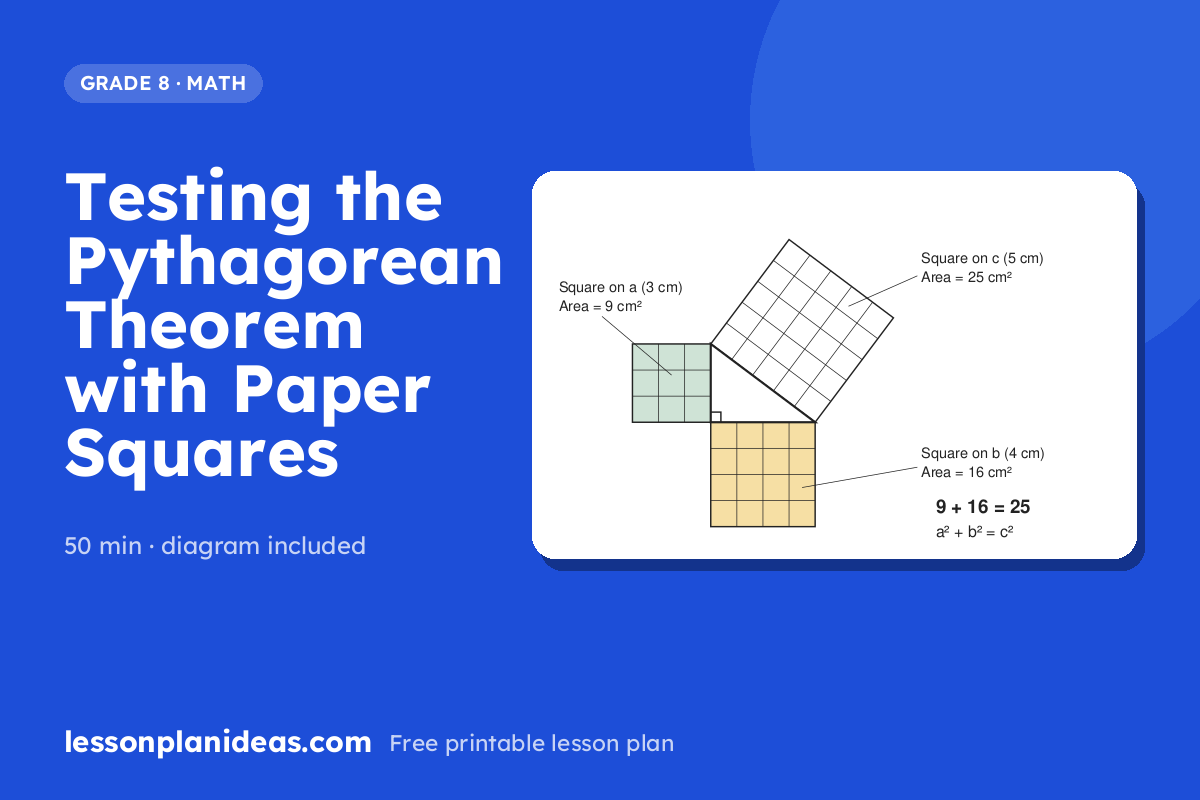
Put students in pairs and give each pair a set of leg lengths for a right triangle, such as 3 and 4 cm, 6 and 8 cm, 5 and 12 cm, or 9 and 12 cm. Each pair draws their right triangle on grid paper, measures the hypotenuse with a ruler, and draws a square outward from each of the three sides, colouring each square a different colour. Students cut out the two smaller squares, cut them into strips or single unit squares, and tape the pieces onto the largest square to see whether they fill it exactly, recording all three areas in a table. Next, each pair draws a triangle that is not right-angled, builds squares on its sides, and repeats the test to see that the pieces no longer fit. To finish, pairs take a metre stick and masking tape and test at least three corners in the room, such as a desk, door frame or bookshelf. They mark 30 cm along one edge and 40 cm along the other, then measure the diagonal between the marks to see whether it is 50 cm. Pairs record each result and decide whether that corner is a true right angle.

Discussion Questions
- Why did the pieces fill the large square on the right triangle but not on the other triangle?
- How does the area of a square on each side connect to the equation a² + b² = c²?
- One corner in the room had a diagonal of 51 cm instead of 50 cm. What does that tell you about the corner, and is it bigger or smaller than 90 degrees?
- Why might builders use 30, 40 and 50 instead of 3, 4 and 5 when checking a large corner?
- Can you find another set of three whole numbers that works the same way as 3, 4 and 5? How would you check?
Exit Ticket
A triangle has sides of 7 cm, 24 cm and 25 cm. Show your calculation and state whether it is a right triangle. Then find the hypotenuse of a right triangle with legs of 9 cm and 12 cm.
Differentiation
Support: Give struggling pairs the 3 and 4 cm triangle with the squares already outlined on the grid paper so they can focus on counting unit squares and cutting. Provide a three-column table labelled Leg Square, Leg Square and Hypotenuse Square, with a sentence frame such as '___ + ___ = ___, so the corner is / is not a right angle.'
Extension: Challenge advanced students to tape a right triangle on the floor with legs of 1 metre and 1 metre, predict the hypotenuse using the theorem, and then measure it to compare. Ask them to explain why the answer is not a whole number. They can also find two new sets of whole-number side lengths that form right triangles and test one by building it with tape.