Modelling Why Daylight Length Changes in December
About this lesson
In this 45-minute Grade 5 science lesson, students use a flashlight and a ball to model Earth's tilt. They observe quietly and record in journals why December brings long nights to some places at Christmas and long summer days to others. You need flashlights, a ball or orange per group, markers, tape and paper or science journals.
- Grade
- 5
- Subject
- Science
- Time
- 45 min
Objective
Students will explain how the tilt of Earth's axis causes different daylight lengths in the Northern and Southern Hemispheres in December, using observations from a physical model.
Materials
- Flashlights or a desk lamp (one per group)
- A ball or orange for each group
- Markers and small pieces of tape
- Science journals or lined paper
- Pencils and rulers
- Chart paper for the class summary
Hook
Dim the lights and ask students to close their eyes and picture the sky outside at Christmas time, whether they celebrate it or simply know it as a December holiday. Is it dark by late afternoon, or bright and warm until late evening? Give students 3 minutes to write or sketch their picture in their journals. Then explain that people in Canada and people in Australia picture very different skies, and today they will find out why.
Main Activity
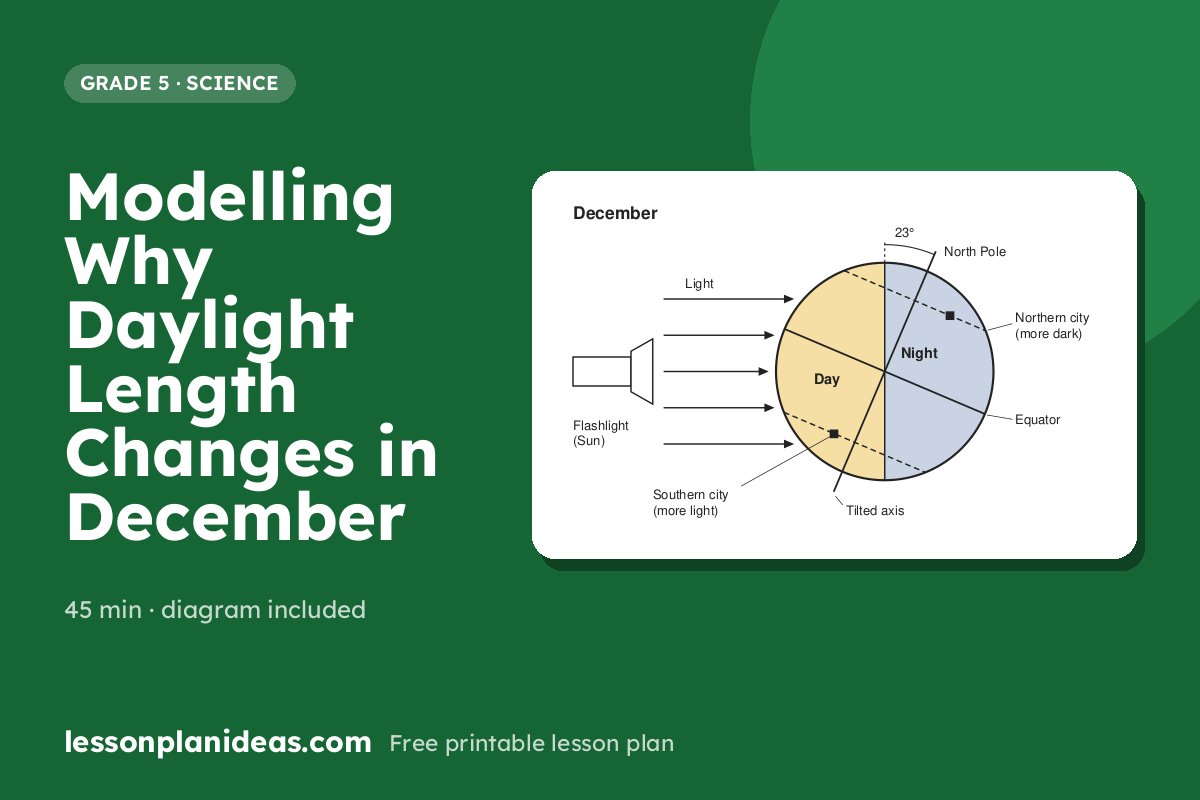
In groups of three or four, students draw an equator line around their ball with a marker. They place one piece of tape about halfway between the equator and the top to stand for a northern city, and another the same distance below the equator for a southern city. With the room darkened, one student holds the flashlight still as the Sun, about 1 metre from the ball. Another student tilts the ball so the top points slightly away from the light (about 23 degrees, roughly a quarter of the way from straight up to sideways) to show December. That student slowly turns the ball one full rotation while the rest of the group quietly watches each tape marker and judges how much of the turn it spends in light and how much in shadow. Each student sketches the setup in their journal, labels the lit and dark sides, and writes a short estimate, such as 'northern city: more dark than light'. Groups then keep the tilt pointing the same direction in the room and move the ball to the opposite side of the light to model June, repeat the slow rotation, and record what changed. End with 5 minutes of silent journaling on this prompt: 'What surprised me about how Earth's tilt shapes our days?'

Discussion Questions
- Why does the northern marker spend more time in shadow during December, even though the ball turns at the same speed the whole time?
- How might Christmas celebrations feel different in a place with long, warm summer evenings compared to a place with long, cold nights?
- What would happen to daylight in December if Earth had no tilt at all?
- What did you notice about the equator marker compared to the other two markers?
- In what ways is our flashlight-and-ball model different from the real Earth and Sun?
Exit Ticket
In 2-3 sentences, explain to a friend living in the other hemisphere why their December days are a different length from yours. Use the words 'tilt' and 'daylight'.
Differentiation
Support: Give struggling learners a pre-drawn journal page with a circle, an equator line and labelled boxes for 'light side' and 'dark side', plus sentence starters such as 'In December, the northern city has more ___ because ___.' Pair them with a partner who reads the model aloud as they turn the ball slowly together.
Extension: Advanced learners add a third marker very close to the top of the ball and observe what happens there during a December rotation. They then write a journal entry describing what Christmas Day would be like near the North Pole and near the South Pole, and explain their reasoning using their model observations.