Using Context Clues to Define Unknown Words
About this lesson
In this 45-minute Grade 3 lesson, children work as detective teams reading pages from a lost explorer's journal. They use the words and sentences around each tricky word to work out its meaning, and each correct meaning leads them closer to a hidden note in the classroom. You need chart paper, handwritten clue cards, sticky notes, pencils and an envelope.
- Grade
- 3
- Subject
- ELA
- Time
- 45 min
Objective
Students will apply context clue strategies (definition, synonym, antonym and example clues) to determine and explain the meaning of unfamiliar words in sentences.
Materials
- Chart paper and markers
- 6 index cards or paper strips, each with one handwritten journal sentence and a hiding-place hint
- Sticky notes
- Pencils
- An envelope with a final note inside (for example, 'You cracked the code. Free reading time with a partner today.')
Hook
Before class, hide the envelope somewhere in the room, such as under the reading rug or inside a book on the shelf. Hold up a crumpled sheet of chart paper and read aloud: 'Day 12 of my journey. I was so parched after walking all day that I drank my whole water bottle in one gulp.' Explain that this page was left by Explorer Sam, who hid a message in the classroom, and that every page has a puzzling word. Detectives must work out each word's meaning to follow the trail. Ask the class what 'parched' might mean and which words in the sentence helped them decide.
Main Activity
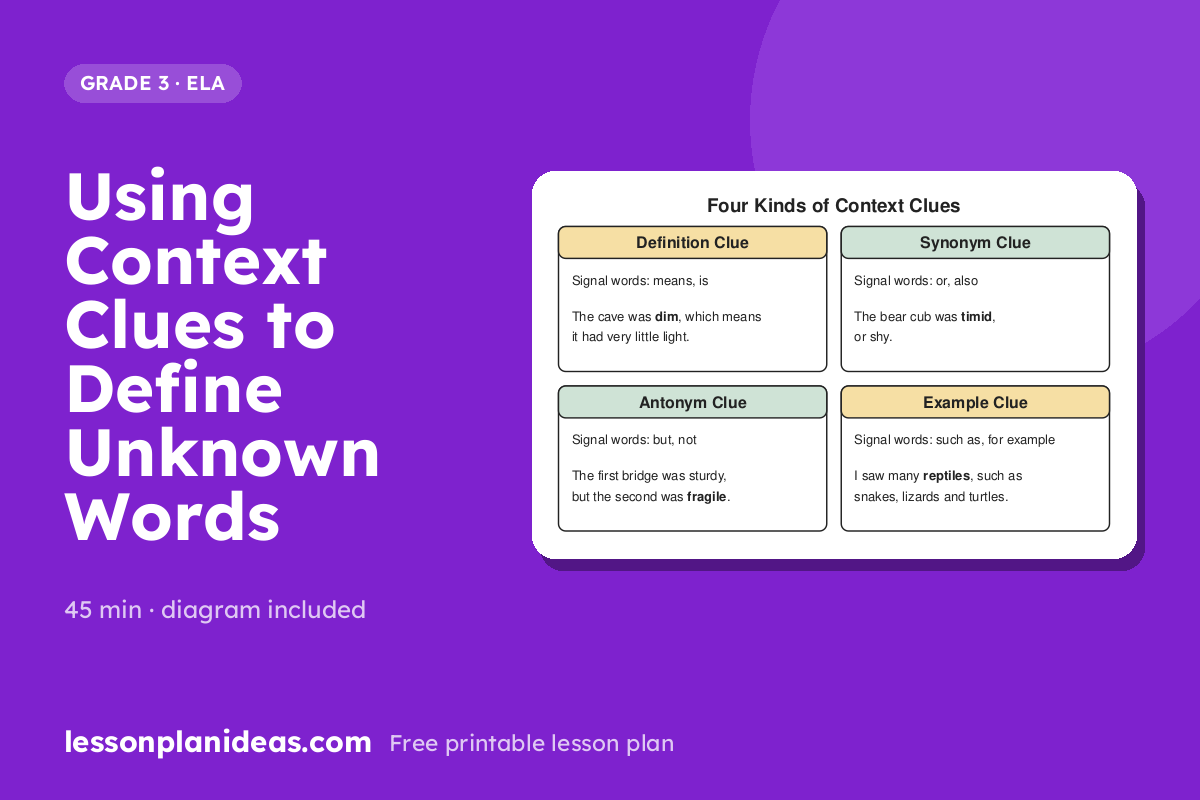
Write the four clue types on chart paper with one example each: a definition clue ('The cave was dim, which means it had very little light'), a synonym clue ('The bear cub was timid, or shy'), an antonym clue ('The first bridge was sturdy, but the second was fragile'), and an example clue ('I saw many reptiles, such as snakes, lizards and turtles'). Divide students into teams of 3–4 and give each team a journal card. Write other sentences on the remaining cards, such as 'The rock was enormous, as big as a house' and 'I felt drowsy, so I curled up and took a nap.' On each card, teams underline the tricky word, circle the clue words, write their meaning on a sticky note, and name the clue type. When a team brings you a correct meaning, read them the matching hiding-place hint from the back of the card (for example, 'Look where words live in rows'). Teams then swap cards until all six are solved. Finally, the class combines the hints to find the envelope and reads Explorer Sam's message together.

Discussion Questions
- Which clue words helped you most, and how did you know they were clues?
- What can you do when a sentence does not give enough clues to work out a word?
- How is solving a word's meaning like being a detective solving a mystery?
- Which type of context clue was easiest for you to spot, and why?
- Where else might you use context clues outside of this mystery?
Exit Ticket
Write this sentence on the board: 'Explorer Sam was famished, so she ate three bowls of soup and asked for more.' Students write what 'famished' means, copy the clue words they used, and draw a small magnifying glass beside their answer if they feel confident.
Differentiation
Support: Give struggling learners cards with shorter sentences and the clue words already lightly underlined. Offer a choice of two possible meanings so they can test each one by rereading the sentence with that meaning swapped in. Pair them with a supportive reader who reads the card aloud.
Extension: Advanced learners write their own journal page for Explorer Sam with two tricky words. Each word must use a different clue type. They then trade pages with another team, who solves the words and names the clue type used.